Political instructor Gavrila
The Painted BirdPolitical instructor Gavrila is both a caretaker and an ideological teacher in the regiment where the unnamed boy narrator recovers. He gives the boy practical instruction in reading and a larger framework for understanding history: a secular world shaped by human action, organized toward collective goals by the Communist Party. His lessons offer the isolated child belonging and purpose, while presenting political discipline as a guide to interpreting and directing events.
Identity and Place in the Regiment
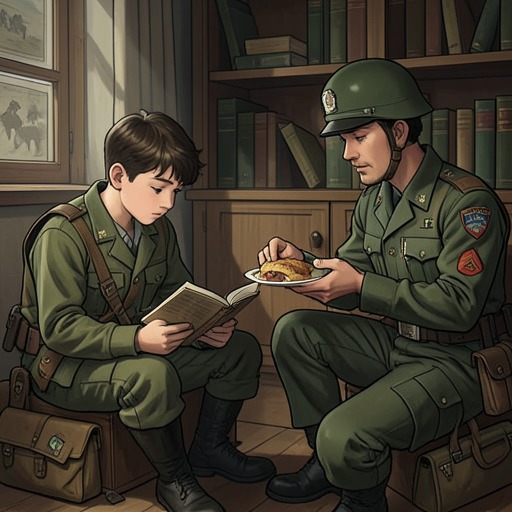
Gavrila is a political officer in a Red Army regiment. Alongside Red Army sniper Mitka, known as Mitka the Cuckoo, he looks after the boy most of the time; the boy is also protected by many of their friends. The regiment around them is orderly and comparatively calm. As news of German defeats arrives by radio and rumors of the war’s end spread among the soldiers, Gavrila’s attention is directed not only to military life but to the boy’s education and formation.
The account says that Gavrila was believed to have lost his entire family in the first days of the Nazi invasion. That reported bereavement gives particular weight to his role as a guardian of a child separated from his own family, although the passage does not describe him discussing his loss with the boy. His care is presented through what he does: he spends time with the child, teaches him, and helps make a place for him within the regiment’s daily life.
Teaching the Boy to Read
Gavrila teaches the boy in the field library, insisting on the importance of literacy because the child is already over eleven. He frames reading and writing as ordinary capacities for boys of that age, alongside the possibility of fighting when necessary. The boy, unwilling to be regarded as a child, studies industriously and watches the soldiers in order to imitate their behavior. Gavrila’s lessons therefore answer more than a practical need: they give the boy a way to claim competence and move closer to the adult world he admires.
The first book Gavrila helps him read is Childhood. Its hero is a boy who loses his father at the opening and, after his mother dies, is left alone. The character’s eventual growth into a great man, Maxim Gorky, offers the narrator hope because the child in the book has also endured hardship. The book’s many shelves in the regimental library and Gorky’s reputation among readers around the world enlarge that example beyond a private story of survival. Under Gavrila’s guidance, reading becomes a means of imagining a life that can continue after abandonment.
The boy also discovers poetry, which he finds prayer-like in form but more beautiful and intelligible. Unlike prayers recited as penance, poetry is for pleasure; its polished words seem to fit together with the precision of millstones. Yet Gavrila’s lessons matter more to the boy than reading as an end in itself. The library becomes a place where literary experience and political instruction meet, and where the child learns to interpret both people and the world through ideas he has not yet been able to formulate alone.
A Secular Account of the World
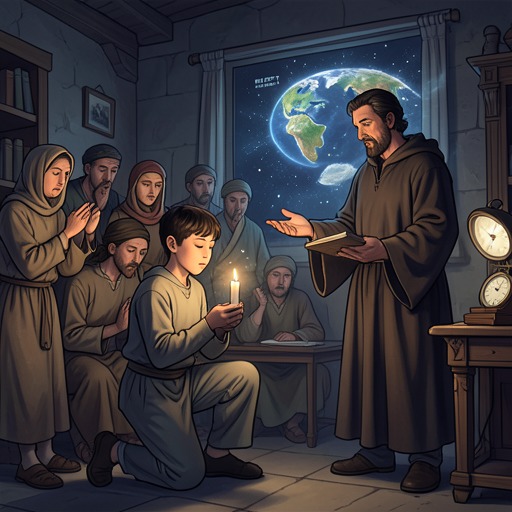
Gavrila teaches that God has no role in the natural order because God does not exist. In this account, priests invented God to deceive people who were ignorant of the world and uncertain of their own powers. Devils, ghosts, ghouls, and the idea of Death pursuing sinners belong to the same rejected supernatural explanation. Against the boy’s inherited religious framework, Gavrila presents natural order and human capacity as sufficient grounds for understanding life.
His argument is not merely a denial of religious belief. He also supplies an alternative source of meaning: people determine the course of their lives and are the masters of their own destinies. Every person matters because individual actions contribute to a larger pattern, even when the person performing them cannot see the result. Gavrila makes this abstract claim tangible through the image of a woman’s apparently random stitches forming a floral design on a tablecloth or bedcover. The image reconciles individual action with a whole that exceeds any one person’s view of it.
Within that pattern, Gavrila says, a leader may emerge from the nameless mass: someone who seeks others’ welfare and has the knowledge and wisdom to understand that waiting for divine help will not improve conditions on earth. Such a leader guides people as a weaver guides colored threads. The contrast is central to Gavrila’s teaching: history is not governed by providence but shaped by human beings who understand its direction and take responsibility for changing it.
The Party, Leadership, and Historical Purpose
Gavrila identifies Communist Party members as people devoted to practical efforts for good. They are selected from the population, specially trained, and assigned particular tasks; they are expected to endure hardship and even death when the working people’s cause requires it. From their position at society’s summit, they can see individual actions as parts of a definite pattern. In his explanation, the Party not only interprets events but shapes them and directs them toward new aims.
The boy is taught to picture the Party as an engine leading working people toward better goals and shorter routes to improved lives, with Joseph Stalin at the throttle. Portraits of great men appear throughout the regiment’s library, field hospital, recreation hall, mess tents, and soldiers’ quarters. Stalin’s portraits are larger and brighter than the others; Gavrila credits Stalin’s leadership with the Red Army’s victories and with bringing liberated peoples a more equal way of life. The boy is told that education, rank, home, the library’s books, and his own medical care and recovery all belong to a wider debt owed to Stalin. This rhetoric makes political leadership intimate: it links the child’s immediate safety and the objects around him to the regime’s account of collective achievement.
The Party’s authority is also represented through its internal routines. Gavrila returns hoarse and exhausted from long, tempestuous meetings where members assess one another, criticize themselves and their comrades, offer praise, and identify shortcomings. Their vigilance is directed in part against people influenced by priests and landlords. The Party, in Gavrila’s account, becomes tempered through this scrutiny and maintains its strength by removing members who impede progress, as a jammed or crooked wheel obstructs a cart. His teaching thus joins care for the boy to a demanding political ideal: a person’s worth lies in serving a collective purpose, and the institution claims the discipline to discern and enforce that purpose.